Showing posts with label romance. Show all posts
Saturday, February 18, 2012
Crash Course in Downton Abbey: The Modern Appeal of a Period Drama
If you're anything like me (and most television viewers), you've probably heard at least whispers about Downton Abbey, especially in the wake of its recent popularity explosion (did you hear it placed second to the SuperBowl?). And if you're like me up until the moment I actually watched the first episode, you're probably wondering what in the world all the hype is about. As a seasoned television watcher and amateur analyst, I like to think I have a certain degree of authority when it comes to telling the people who are silly enough to heed my advice what they should watch. And even if I didn't feel I had that authority, I would probably still be telling you to watch Downton Abbey. It's that good.
Now, you might be thinking that despite my glowing praise you still won't enjoy the show, because let's be honest, sometimes I like very obscure things that don't have as broad an appeal as I think they do. However, I think the case can easily be made that Downton Abbey has a little bit of everything the modern television watcher is seeking: cultural relevance, chaste romance (because come on, aren't we all a little tired of seeing so much sex on TV?), political rumblings, the impact of warfare, and oh yeah, Maggie Smith being the best outspoken grandmother on television. The reasons abound for you to tune in, and the timing couldn't be better: the finale of season 2 airs this Sunday on PBS' Masterpiece Theatre, which gives you about 30 hours to catch up on the prior 13 installments.
Occupy Downton
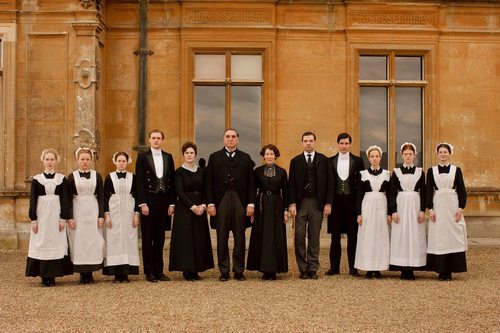
If you're looking for an interesting examination of the 99% vs. 1% problem that (most likely) doesn't hit too close to home for you, the class division between the Upstairs and Downstairs crews on this show is both intriguing and relevant. Of course, the Crawleys are a bit more benevolent than the Wall Street types who are gobbling up all the money these days (though they might not seem it at first); they are creating jobs, after all, and they are almost always willing to give the servants the benefit of the doubt (excluding Thomas, who of course doesn't really deserve it). The Ladies Crawley are even more progressive than their parents, and are often to be found sympathizing with the servants and actively trying to better their lot (think Sybil helping Gwen score a secretary position, Anna's rapport with and concern for both Carson and Anna, the whole house's investment in Mr. Bates' fate). Add to that the fact that at the end of the day the servants have a consistent roof over their heads and food to eat, and you could do a lot worse than Downton Abbey for minimum-wage employment.
The Times Are A-Changin'
One of the most interesting features of this show is the vastness of the time period it's already managed to span. In the course of no more than 14 episodes (at least the way PBS has divided them), we've literally traveled through almost a full decade, with the first episode opening in the days following the Titanic disaster (in April 1912) and last December's Christmas episode taking us through to January 1920. Needless to say, there is a huge evolution of culture in the intervening time, with the Victorian splendor of the 1800's gradually giving way to the confused and changed world that emerged in the aftermath of the Great War. This is a time span that often gets overlooked in contemporary film and television (whereas WWII and the Vietnam era are given almost too much attention), and it is incredibly interesting (especially if you're anything of a history nerd like I am) to be plunged into such a compelling experience of the moments most of us have only read about in history books. Stories of the past always feel nearer to us when they're given a human face, and Downton Abbey's writers have absolutely mastered this.
Good Old-Fashioned Romance
There's a pairing for everyone who watches this show, it seems. Matthew and Mary are of course the star will-they-or-won't-they romance (Michelle Dockery remarked in an interview that she'd heard them referred to as the "Ross and Rachel of period drama", which is both hilarious and fitting), their longing glances and loaded exchanges surviving even the darkness of World War One and an endless strings of miscommunications and misunderstandings. For those looking for a relationship built on genuine compassion and patience, you've got the seemingly doomed romance of Anna the ladies maid and Mr. Bates the valet. It seems the universe will stop at nothing to try to keep these two apart, despite their endlessly good intentions. And of course, there is the rebellious romance between Lady Sybil Crawley and Branson the chauffeur which is not only a meeting of two politically inclined minds but which shatters the assumed barrier between the Upstairs and Downstairs dwellers (plus he's got an adorable Irish accent to boot). Though the romances themselves occasionally veer toward the soap opera-esque, it is satisfying to see how such well-articulated characters can complement and even improve one another in a world still preoccupied with increasingly archaic social constructs and concerns.
Stings, Doesn't It?
Of course, all of the characters on this show are well-spoken and many of them dispense a great deal of wisdom and wit. There is no competition, however, when it comes to the best one-liners and overall commentary. That honor goes to the Dowager Countess of Grantham herself, portrayed flawlessly by Maggie Smith. Chances are, if the DC is talking and whatever she's saying sails right over your head, someone just got majorly burned. Also, she really hates Americans.
This show has the potential to make you laugh, cry, and lament the death of chivalry all in one sitting. Not to mention, the British accents will make you feel like you're indulging in something classy, even if you're only watching to see the next twist in your favorite romance unfold. And for those who want to appear in the know right off the bat, remember that it's DownTON Abbey and not DownTOWN Abbey. It'll save you a lot of time and embarrassment, take it from me.
Monday, November 7, 2011
Movie Review: Like Crazy
If you've seen the trailer for this movie, in a way you've kind of seen the whole movie (except the trailer is kind of better, what with the great music and all). Like Crazy is charming and full of angst and an overuse of montages, which of course makes it indie-film-junkie heroin. I enjoyed the film on the whole, and I grant that the two lead actors (especially Felicity Jones) compensate for a lot of plot problems with their undeniable charm and chemistry. However, they don't make up for how frustrating the very premise of this film becomes if you're like me and you start really thinking about it right there in the theater.
The biggest issue I have with it is that the entire central problem of the film arises because Jones' character Anna, makes an extremely stupid decision. If that were all I could maybe forgive it, but she knows exactly what she's doing when she does it, and is just (apparently) dumb enough to not consider the possible consequences. The basic gist is this: Anna is an immigrant from England, in Los Angeles on a student visa. Her visa expires upon her graduation, and she has to spend two months in England for the summer before she can come back to her beloved boyfriend of one year, Jacob. As anyone who's ever dealt with a visa or even looked into it, you know that these deadlines are not by any means flexible, and the consequences of violating a visa deadline are extremely severe (I'm also certain they impress this upon you many, many times in the application process). Anna, however, decides even after she and Jacob have accepted this necessary two-month hiatus that she'll just stay in the States through the summer. Who's going to notice, right? Wrong.
Because these two are absolutely stupid for each other (and I mean that in the least flattering way possible), Anna gets herself banned from the US indefinitely because she can't bear to spend 8-10 weeks away from her boyfriend (and of course he idiotically agrees to anything she says). The rest of the film is basically them as an on-and-off couple, with Jacob visiting intermittently as they try to get the ban lifted (and never once realizing that he could simply move to London until Anna is allowed to leave; his flimsy excuse is that he sells furniture in LA, which apparently is impossible in any other country). They whine and cry (a lot, there are a ton of tears in this movie), and date other people and send each other letters, and the entire time I cannot bring myself to root for them because of their shared stupidity.
Eventually they decide to get married, but even that doesn't immediately succeed in getting Anna's ban lifted. And then, naturally, their relationship begins to really unravel due to jealousy and of course the angst of being two idiots in love. The film ends on a somber note, with Anna's ban lifted at last, and her coming to LA to stay with Jacob (presumably indefinitely, though it isn't clarified). In their last scene together it becomes clear that a great deal of the initial magic of their relationship is gone, and maybe all this struggle wasn't really worth it after all. And I would absolutely feel sympathy for them, if it weren't for the fact that Anna could have gone on that two month break to England and they could've realized the staying power (or lack thereof) of their relationship years earlier than they ultimately do.
But hey, the cinematography and the soundtrack are pretty great, so I can see why it was a favorite at Sundance.
Wednesday, August 24, 2011
Movie Review: One Day
As book-to-film adaptations go, this one falls somewhere between extremely well done and tolerably done, and I can't really pinpoint where on the spectrum it fits. I do think if a viewer hadn't read the novel before seeing the film they might have enjoyed it more than I did, simply because it was so fresh in my mind and I was busy cataloging omissions and alterations. That said, I found it very watchable in spite of myself.
Most of my hunches about this film turned out to be right. It was produced by Focus Features, which guaranteed a certain artistry and visual appeal, so I was not let down there. Anne Hathaway and particularly Jim Sturgess gave solid performances, and Sturgess was particularly heartbreaking in his portrayal of Dexter's downward spiral. Additionally, the under-utilized Patricia Clarkson was great as Dexter's ailing mother, and I definitely wouldn't have been opposed to seeing a bit more from her. I knew going into the movie that it was going to be difficult to translate a lot of the character's interiority that we get to see in the novel, and that is probably where the film suffers the most. Someone mentioned in another review that it was hard to figure out at times why these character stuck by one another for so long (particularly Emma once Dexter started evolving into a grade-A jerk), and I could see how this was a problem-- the book just does a much better job explaining why they each need each other so much, but in a way that couldn't really have been put onscreen unless they inserted a lot of monologue-ing, which would definitely have gotten old. For similar reasons some of the movie's segments felt rushed, like they were jumping from year to year too quickly and not giving us enough time to immerse ourselves in each episode individually.
All these problems were minor for me because I'd more or less expected them, and if you do the same you'll probably enjoy the film for what it accomplishes, which is a convincing portrayal of a modern love story, complete with realistic obstacles and outcomes. One thing that was very frustrating for me, however, was how one-sided the writers/directors made things in the first third or so of the film-- it definitely looked as though Emma was (even a bit stupidly) head over heels for Dexter while he had her firmly in the "friend zone," when in the novel this was not the case. There is a great "almost" moment regrettably omitted from the film in which we see Dexter drunkenly compose a lengthy letter to Emma during these very early stages of their romance, confessing some of his feelings and begging her to meet him in India. In the novel he never sends the letter, but the feeling of "what could have been" achieves a very strong sense of emotional connection that not only helps the reader stick with Dexter when he slides the slippery slope into douche-dom, but also establishes a fear on both characters' parts of actively pursuing their love for the other, one that lingers for many years to come. I think this might have been the most grievous omission from the film, because it could have conveyed so much in such a brief and simple way.
For all my complaining, though, I enjoyed the film. It was equal parts romantic (and at times cheesy) and funny, just like the novel. The way the last few chapters of Emma and Dexter's story were handled was particularly affecting, and it will probably tug more than a few tears from you. But perhaps the best part of the film is that it really does retain the "real" factor of the book, allowing the audience to feel a larger connection with these two very ordinary characters who happen to stumble upon something much larger than either of them.
Saturday, August 20, 2011
Book Review: One Day by David Nicholls
This novel is yet another in the alarming trend I've begun of reading books that hit entirely too close to home. Yes, One Day is on the surface a love story, a romance between two people told over twenty years, but it's about so much more than that. Nicholls examines the condition of young people in the modern age with such stark honesty and unapologetic truth that, for the recent college grad only beginning to embark on the "rest of my life" path, a lot of the story (most particularly the parts that aren't intended as tragic) read with a profound sadness.
Emma and Dexter officially meet on the day of their graduation from university, July 15th 1988. They spend the next 24 hours getting to know each other (no, not in exactly the way you're thinking, though there is some snogging), and their relationship is revisited on July 15th of each subsequent year, during which they always have some sort of significant interaction or event taking place in their respective lives. Each of them veers down a misguided path at different points, and though many readers would probably jump to vilify Dexter for the caddish drunk he becomes in his late twenties, there is something even more regrettable about Emma's descent into boredom and complacency, her refusal to take chances and for a while, to pursue her true ambitions. Both characters spend much of the story lost in this manner, unsure of themselves as they attempt to navigate the transition from adolescence to adulthood with little initial success. They are utterly miserable and you feel miserable reading about them, especially as it becomes clear that the lone bright spot in either of their lives is the other, a fact that they spend entirely too many pages refusing to realize.
There is also an overarching theme of wasted time, and the opportunities we miss out on in life and in love. We see several moments when Dexter or Emma very nearly takes the plunge, trying to change the status of the relationship, but they are foiled again and again by their circumstances or their own respective cowardice. This is a story that, contrary to what the advertisements for its film adaptation (more on that in a bit) would have you believe, does not have a happy ending. What I loved so much about it though was that I didn't want it to. This story has a painfully real ending, and it is everything these two characters both do and don't deserve. Nicholls takes us on a journey that we can empathize with because it could so easily be my story, or yours or his or hers. It's universal, this struggle to be that we watch Emma and Dexter endure, and the book concludes on a bittersweet note, one that has stuck with me (and, I expect, many other readers) as a lesson, or perhaps a glimpse of what our own futures might hold if we aren't careful. One Day is a snapshot of life as most of us know it, and it is a better story for making no apologies for that.
As for the film adaptation, which opened in theaters yesterday, I am definitely interested to see how it pans out. I can already tell where there might be some creative liberties taken, and those changes may or may not translate well on screen. There are several factors, however, which encourage me to think it might be a reasonably good adaptation: the performances of Jim Sturgess and Anne Hathaway, both of whom are more than capable of delivering the kind of emotional connection this novel begs; the fact that Nicholls himself wrote the screenplay, thus hopefully ensuring that the original intent of the story will not be lost; and most importantly the fact that this film is being released by Focus Features, which for me is as good as a guarantee of it's quality. Some of the reviews I've read (I don't like to read too many going into a movie, at the risk of biasing myself) have been very negative, while others have indicated that it might be right up my alley. I am determined to find out for myself, hopefully soon, and will have my full thoughts here once that happens. In the meantime, I encourage anyone looking for a heartfelt, genuine read to give One Day a chance.
Friday, May 20, 2011
Parks and Recreation Season Finale: Two Roads
Wha...? But they were (I was) so happy! And then--but are they--wait, what did I just watch?
That's the summation of how I felt about the last five minutes of "Lil Sebastian," when we saw Leslie's game-changing moment and hints at the potential fallout. But there is almost a full two episodes to cover before we get to that. First, let's check how I did on my finale predictions:
*Lil Sebastian was the one to die, as expected.
*We did in fact see Tom hand in his resignation to pursue his dreams
*Ann did have an interaction with Chris, though it was different from what I expected. Chris is surprisingly still in the dark about Ben and Leslie, and so their conversation had nothing to do with the wayward couple. I did like that Ann seems to finally be over her past with Chris, and that they were able to talk as friends. I initially hoped that Chris' musing after she left was a sign that he might relax his policy about inter-office dating just a little, but by episode's end that wasn't even the biggest problem on the Ben/Leslie front.
*In fairness, I think the interview I cited in my predictions oversold the Ron/Tammy thing a bit. I was expecting an actual storyline rather than a relatively minute interaction, though I am interested to meet Tammy #1 (and see who'll be playing her), and to find out why she strikes so much fear(?) into Tammy #2, who bolted upon seeing her.
*As I forecasted, little developments with Andy and April were all we saw, like the show was trying to check in with them every time we needed a cute moment.
*I admit that I was completely off the mark in my assessment of what would happen with Leslie and her job. Chris' overhaul of the Parks Department seemed not to affect her at all, busy as she was with other matters, and the political recruitment plot was not something I was expecting to see this early in the show's run (though in fairness I guess they want to move it along and set up for a potential game-changer in a season or two. Leslie isn't going anywhere any time soon, but Ben might be? I was disappointed and surprised by this, but we'll get to that, I promise.
First, let's go all the way back to the beginning of "The Bubble" when things were a little bit sunnier. Ben was super awkward this episode, in a way that was almost difficult to watch. His meeting with Leslie's mom was a particular example of this, and I'm just glad they didn't put us through watching the entire exchange.
We saw Tom and Andy get banished to the fourth floor per Chris' revamping of the department, and I loved Andy's irrational enthusiasm about helping out with such a menial task, in contrast with Tom's loathing, which built nicely (I especially enjoyed him bickering with the elderly women in the office).
Leslie teaching Ben how to deal with her mother was amusing, and Ms. Knope Sr. liking him maybe a little too much was doubly so. Two things bothered me about this plot initially: one, Leslie and Ben were spending way too much time together to be legitimately passed off as just work, and two, I don't think Leslie actually did any of her own work all day. These things both proved to be a hint of things to come in the night's second episode (their many failures at secrecy and the relationship in general impacting the quality of their work), but it seemed like they were being too reckless right off the bat. Both of them said on several occasions that they both didn't want to break up and didn't want to get fired, I just thought that neither did a very good job of showing that they meant it. The only person I was glad to have find out about their relationship was Leslie's mom, especially because her approval of Ben clearly meant a lot to her daughter.
Let's move on to talk about "Lil Sebastian," where my heart started to crack (and not because of the mini-horse funeral upon which the episode's plot focused). There is a lot that happened in a very short time, and a lot of questions left unanswered, which means I will undoubtedly spend my summer wondering where things are headed.
Right off the bat we got more of Ben and Leslie just sucking at keeping their relationship a secret, to the point of it being really frustrating. I mean, they kept their attraction to each other secret for ages (Ben didn't even know for sure that Leslie was into him until "The Fight"), but now they're suddenly incapable of behaving like adults? I know why it was written this way, and what it was intended to do, I just still don't know if I buy it.
I really liked Ron being the first one to find out about the relationship, although I'm a little disturbed by how long he stayed on the line after Ben accidentally called him (and more than a little disturbed at the content of the conversations he overheard). I liked that he was upfront with Leslie about the risk she was taking, assuming that fatherly role he sometimes does (reluctantly) when it comes to her. You could tell that he doesn't actually oppose their relationship, just opposes losing his most valuable employee.
Chris' struggle with death during the funeral proceedings and his health "scare" probably should have humanized him a little, but I couldn't not laugh. It was just so absurd to think that someone so obviously concerned with prolonging his life and health has never fully realized that he's eventually going to die.
And of course that last scene with Leslie. She and Ben had just agreed to really try to tone it down (in other words, to do what they should have been doing the entire time) and be as professional as possible, when she was approached by political recruiters (would that be their official title? I know nothing about this). The Leslie Knope enthusiast in me was overjoyed that she's finally being recognized for her work and offered an opportunity that she desperately wants, but the Ben and Leslie "shipper" part of me wanted to cry. Of course they aren't just going to let her get away with choosing between her current job and her boyfriend; they're going to throw another wrench entirely into the machine and make her choose between him and her biggest aspiration. The episode left it up to us to speculate on what her "no" to the scandals question meant (is she going to break up with Ben? or did she just do herself in by lying about the first thing they asked?), not to mention that sad look through the window.
I honestly don't know which way it will go; there are obvious downsides no matter what. If she stays with Ben she risks her political career blowing up in her face before it's even gotten off the ground; if she dumps him she's sacrificing a relationship that at least two people in her life have expressed support for (not to mention the implication that she's already happier with Ben than she has been with anyone in the past). Both the relationship and the career can make her happy, but Leslie (and the viewership) is learning that in a non-ideal world, you usually only get to choose one path to potential happiness.
I'm going to count down the days until September trying to find a loophole wherein she can have both. Because Leslie is above all else an average gal, like you and me. And if she can have the best of both worlds, maybe we can too.
Tuesday, May 17, 2011
Soundtrack Series, Part Two: Sounds of Love
I'm not a romantic. Okay, I actually think that sometimes I am a romantic, but not in the way you'd expect. I hate chick flicks and happy endings. I'm not planning on waiting around for "Mr. Right" to find me in the hopes that we'll ride off into the sunset together. The roles of wife and mother don't really appeal to me at all, especially in competition with writer or teacher or any number of ambitions I haven't yet discovered.
But I believe in love. All of my stories feature it pretty heavily; the novel I'm writing is pretty much a 300 page treatise on why when we lose our ability to love we lose ourselves. And I have a soundtrack, not a formal one, but a cluster of songs in the back of my mind that remind me of what love feels like, what it sounds like. As you might expect, they're not all happy (all right, I'm lying, most of them are pretty melancholy) but the meaning they've got packed into them is worth a million crappy pop songs about soul mates and dating and weddings.
**And no, I'm not sure what it means that so many of them have one-word titles.
Faithfully -- Journey
If I am ever visited by the urge to get married and I have a wedding and there's a first dance, this song is it, beyond a doubt. Not only do I unabashedly adore Journey, I love the epic build of this song. And of course I'm a sucker for the lyrics, too. As if none of that were enough, my love for this song was only reinforced tenfold when I heard it covered on "Glee" by the fantastic Lea Michele (and Cory Monteith), though I would definitely insist on the original version at my wedding.
Honestly-- Bethany Joy Lenz
It's not a secret that most of these are songs more focused on the heartbreak side of love than the warm & fuzzy (what can I say, it's who I am). This song is about regret, but it's also about the endurance of loving someone even after things have gone south. Take this line "I'm so glad you're far away/Is that a terrible thing to say?/Still I wonder if you're okay..." Yes, she's nursing a broken heart and maybe even bruised pride, but there's still love there, and I think with any relationship that's ended it's important to remember that you loved that person once upon a time.
Someday We'll Know -- Mandy Moore and Jonathan Foreman
Something else I'm a sucker for: the couple who can't be together or shouldn't be together because of circumstances beyond them. Yes, it's true that there are a lot of people who like these types of stories, but I think I'm in the minority in that I don't root for them to defy the odds/overcome whatever obstacle is impeding them. I prefer them longing for each other, moving forward as individuals, and maybe even learning something from the experience. The two people in this song haven't figured it out yet, but they will, and the romantic side of me loves that.
Yellow -- Coldplay
Whoever it was that introduced Chris Martin to odes and/or to songwriting, thank you. This song is just such a beautiful tribute to a person who is literally the light of another person's life. I can't say much more about this (my words wouldn't do it justice), so I'll just say that I'm pretty sure it's a no-brainer on a list of love songs.
Iris -- Goo Goo Dolls
Another pretty obvious/typical choice, but I had to stick it on here. "You're the closest to heaven that I'll ever be"-- what person, romantic or not, wouldn't want to hear something to that effect? We also get a strong sense of the person singing the song as a complicated, even troubled figure, and the subject of the song being a source of salvation and comfort. It's not a story song, but it makes you want to know the story behind it.
Someone Like You -- Adele
There had to be a song in here about the one that got away. It's a staple of every love song list, and Adele's contribution to the catalog is nothing short of phenomenal. There is something so raw and beautiful about every aspect of this song-- the simply piano, the lyrics dripping with longing, and of course that absurdly beautiful voice (I'm pretty sure she could cover just about any song and I'd love it). When I discovered this one, it shot straight to the Most Played on my Ipod; there's just something about it you won't be able to get out of your head.
For the Nights I Can't Remember -- Hedley
This one's a great song from a pretty unknown Canadian band, and it's all about appreciating all the things, big and small, that the person you love does for you. It's about wanting to be a better person in return, because of how much you love them. And it's got that alt-rock vibe that I thoroughly dug during my high school daydreaming phase (not to mention the fact that it was featured on Degrassi, which is pretty much the epitome of adolescent understandings of love).
Your Ex-Lover is Dead -- Stars
This is probably my favorite breakup song ever. There's so much venom in such simple lines, and it's sad while also expressing a push to move forward. I love the way they take literally the idea of forgetting or un-knowing someone you used to really love, and the way it comes to a resolution. Best lines: "I'm not sorry I met you/I'm not sorry it's over/I'm not sorry there's nothing to save."
Call It Off -- Tegan and Sara
The Temptation of Adam -- Josh Ritter
I absolutely love songs that tell a story, and this is one of my all-time favorites. In about 4 minutes of song, Josh Ritter weaves a beautiful little tale of two people assigned to man a nuclear arsenal beneath the ground, and naturally they fall in love. The temptation is "Adam's" impulse to simply allow the world above them to end so that they can continue to be together. I've read a lot of pretty intense love stories in my time, but I think there's something uniquely moving about this one.
First Day of My Life -- Bright Eyes
I've seen this on a few occasions recently as a wedding song, and while some have scoffed that it's a hipster choice, I disagree. It's a simple little song, and Conor Oberst's vocals leave much to be desired at times, but the beauty is in the simplicity, in the offbeat-ness of it. "I'm glad I didn't die before I met you," Oberst sings, and isn't that how we all feel about the ones we love?
Come Home -- One Republic
This song, one of One Republic's best in my opinion, is truly beautiful. Half plaintive plea, half "dreaming out loud" about a better world, it gets across something that is very difficult to articulate. I think there's definitely a message here that it's okay to need people, as long as you can appreciate that there is still some beauty in your life without them, it would just be clearer if they were around. Additionally, the version featuring Sara Bareilles on the second verse is even more gorgeous than the album cut.
Labels:
Adele,
Bethany Joy Lenz,
Bright Eyes,
Coldplay,
Goo Goo Dolls,
Hedley,
Josh Ritter,
Journey,
love,
music,
One Republic,
Ray LaMontagne,
relationships,
romance,
songs,
soundtrack,
Stars,
Tegan and Sara
Friday, May 13, 2011
TV Review: Parks and Rec's OMG-worthy Episode
So, it turns out the non-stop Blogger outage yesterday might have been a stroke of luck for anyone reading this, because I think if I'd tried to blog about "Road Trip" last night, it would have looked something like this:
"Leslie and BEn OMG SO HAPPYSFLDKSFJDSLGJ G."
Seriously though, I'm such a shameless fan-girl when I've really gotten invested in an onscreen couple. But since I've now watched the episode through twice (and watched the last scene, as predicted, approximately 200 times-- not entirely my fault, Tumblr fans are notorious for posting repeat GIFs), I think I should be able to actually articulate some real thoughts about what happened (and yes, there were other things that happened in the episode, believe it or not).
Leslie and Ben were not the only couple that we got a romantic gesture from last night. Andy and April, who got into a tiff following Tom's "Know Ya Boo" game (complete with CGI dog co-host!), found themselves at odds over April's lack of pride in Andy's music. To be fair, I have to agree that Neutral Milk Hotel, which I doubt most of the people who watched last night have ever heard of, is amazing. But you should know by now April, that your shoe-shining, formerly pit-dwelling husband has a bit of a fragile ego at times. Anyway, they made up, with her playing one of Mouse Rat's songs in a public display of vulnerability (and unexpected musical talent). The plot itself was a bit predictable, but I think the point was to let us focus on the Leslie/Ben goodness without too much distraction.
And of course, Ron's "lesson" about government with the little girl at his office? Precious. For some reason, I love it when a misanthropic grown up befriends a kid or a cute animal; it's never not hilarious and kind of endearing. My favorite moment was probably him asking her to autograph her original essay (Prompt: Why does government matter? Her Ron-influenced answer: It doesn't.).
Well now that that's out of the way, let's get to the good stuff. Leslie and Ben's road trip was the perfect next step for them, especially following the opening scene ("that was the most sexual tension I've ever seen in a conversation about documents"), and I could not have been more pumped. Leslie's attempt to be the anti-seducer was hilarious (Whale sounds! Learning Mandarin! Johns Hopkins' dorms!), as was Ann's "sabotage" via the one and only Al Green. I loved that Ben didn't let Leslie's bizarre behavior deter him-- yet another sign of how great these two are together. And when they were doing the presentation and he talked about how "special" Pawnee is? If you watch Leslie's face during that, you can basically see her falling in love with him all over again. Such a great moment.
The heart to heart at dinner was such an amazing payoff for weeks upon weeks of these two dancing around each other, and I think there was a collective audience half-sigh of relief. We also got a classic Leslie line: "I'm going to go make out with him now. On his face." Then of course Chris had to show up and ruin things, again. I'm sorry Rob Lowe, but you are quickly becoming the face of the most annoying character on television. Sleeping under the same roof at Chris' condo (at his insistence) must have been torture for Leslie and Ben-- I don't think I've ever felt such strong sympathy for two attractive people who are inevitably going to live happily ever after.
And that kiss. Oh my goodness, that kiss. Both of them seemed to shed their awkwardness in that moment and were just two people ridiculously in like (maybe love) with each other, and it was fantastic. It was so reminiscent too of the first kiss Jim and Pam shared on "The Office" (makes sense, given the shows share producers and some writers), but it was also trickier because the tyranny of Chris and the threat of hurting their careers lingered in the room with them. "Uh-oh" just about sums it up.
Season finale next week offers up an hour-long two-part episode that I for one cannot wait to see. I've read some speculation on what's going to go down, but rather than spoil you I think I'm going to just advise that you watch it if you weren't planning to already. I fully anticipate a fantastic conclusion to a phenomenal season of television.
Friday, April 22, 2011
Book Review: I Wish Someone Were Waiting for Me Somewhere, By Anna Gavalda
This is a charming little collection of short stories about people living in France, specifically the more humdrum areas surrounding the glamour of Paris. I picked it up based on a recommendation from one of the innumerable book blogs I read every week, under the assurance that, despite appearances, this was not chick-lit.
The author of that blog was being about 85% honest. Yes, I was pleasantly surprised at the minimalist, dialogue-focused style (the one that, unfortunately falling into stereotyping, I tend to associate more often with male writers) and the lack of over-romanticizing things. Each character in each story, particularly the female protagonists, had a refreshing cynicism and cautiousness in his or her manner, and even the most woebegone characters were far from whiny.
Two stories I particularly enjoyed and which stuck with me were "For Years" and "Clic-Clac" which were for me the most genuine (the former) and the most humorous (the latter). Both are tales of unrequited/unfinished love, and each takes pains to avoid underestimating the reader. "For Years" has a couple who has not seen one another in a very long time, and indeed believes they never will again. Yet one day, out of the blue, they are reunited, and their encounter is, I would say, Gavalda's best work in the volume. "Clic-Clac" is a tale of a man who lives with his two sisters and who lusts embarrassingly after a female co-worker. Naturally, various hijinks abound. This one just has so many laughs, and things you could see actually happening in real life, that the reader is immediately pulled in to the interior of a man who might otherwise seem very pathetic.
Two entries I could have done with out are definitely "Pregnant" and the Epilogue. The Epilogue is what appears to be a fictionalized story of one of Gavalda's own attempts to get herself published, and apart from seeming kind of self-involved, it just wasn't very engaging. And "Pregnant" is the story that almost made me put down the book-- the protagonist is a "typical" female, overly sentimental and borderline mentally unstable (at least, it seems that way), and the concluding plot twist is so obvious from the very beginning that it was hard to get invested in any of the rest of the story. I honestly just wanted to flip ahead and verify that my guess was right (and of course, it was), rather than read pages upon pages of this protagonist being exactly the kind of woman I usually loathe.
Overall, though, I'd recommend this based on the two stand-outs, and for a fun little read in between more serious texts (I've been studying Paradise Lost and The Great Divorce, so Gavalda's frivolity was a lovely reprieve), not to mention a very charming little snapshot of French quirkiness and style.
Subscribe to:
Posts (Atom)


